"It's Not Me! It's Not Me!" (A Theological Exploration of the Movie OBSESSION)

Updated: Sep 8

"Jesus was not a theologian. He was God who told stories." ~ Madeleine L'Engle (Walking on Water)
Jesus' teaching style shows us that parables - stories with meaning - seem to be one of God's favourite ways of communicating. So it makes sense for Jesus-followers to always be open to hearing God speak through stories. And recently, I heard his voice through the movie Obsession.
My friends tell me I'm obsessed with Obsession, and I would agree. It hit me with the right message in the right way at the right time in my life. Whether or not you dig the movie, if you love theology, I'm hoping this article will be helpful. I'm looking forward to the comments here and over at Black Sheep Bible Study on YouTube where you can watch this content in a video essay.

INTRODUCTION
Have you ever done or said something and immediately thought: "How could I be so stupid?" or "Why did I do that?" or even "That’s not me!"
You know the right thing to do, the Bible tells you the right thing to do, your conscience confirms to you the right thing to do, you are convinced it is the right thing to do, and you want to do the right thing to do…
And then you do the opposite.
If so, I get you. And so does the Bible! It's what the apostle Paul talks about in Romans 7, and we'll get there shortly. But first, let’s talk about the movie.
Let me begin with a disclaimer: BLAME ME NOT CURRY. By examining the movie through a theological lens, I am not suggesting that the writer/director Curry Barker intended any of this. I am not claiming to have uncovered the director's secret intent. I am using the movie Obsession as a launching pad into some theological reflection.

OBSESSION: MOVIE OVERVIEW
In the Fall of 2025, a small independent film premiered at the Toronto International Film Festival (TIFF) that would go on to break all kinds of records, including the highest grossing film of all time made for under $1 million, and being the first movie since E.T. in 1982 to make more money on subsequent weekends after the opening weekend (outside the Christmas season). Obviously, word of mouth was undeniable.
The movie is Curry Barker’s Obsession.
Now, I love a good possession movie as much as the next guy (don't we all?), but this movie turns the whole idea on its head. Obsession is about, among other things, the theme of losing control of ourselves, not to a demon or other alien entity, but to a version of us that is not us.
Nikki is invaded by a version of herself that acts contrary to her will when Bear (short for Baron) wishes that Nikki would love him more than anyone in the world. He makes his tongue-in-cheek, off-the-cuff wish with the help of a cheesy retro toy called a “One Wish Willow” – and it works!
At first Bear doesn’t believe in the power of his wish and just accepts that Nikki really digs him. But eventually the truth becomes undeniable – his wish is forcing Nikki to act obsessively toward him, against her will. Once he knows this, Bear has a choice to make: try to help Nikki, the real Nikki, or continue to take advantage of wish-Nikki’s “love” for him.
Obsession is a morality tale that presents like a classic "be careful what you wish for" story, like The Monkey's Paw, the story of King Midas, and perhaps even the story arc of Victor Frankenstein and his growing resentment toward the monster he created. It's ultimate gift to the viewer (that's us!) is the chance to reflect on our own weaknesses and motivations in relationships. For those who have ears to hear, Obsession offers us the opportunity to investigate what true love is, as opposed to the romantic infatuation that often passes as love in our contemporary society. (I've written an article on that topic here, and recorded a video version here.)

Unfortunately, one of the most common online reactions to a movie like this is to judge the characters from a distance, perhaps to make us feel better about ourselves and our own life choices. My hope is that I (and you too!) refuse the self-flattering judge-from-a-distance approach and don't miss this opportunity to learn and grow and self-reflect in our discussion of Obsession.

VIEWING OBSESSION THROUGH DIFFERENT LENSES
Let's approach Obsession as a modern-day parable. Perhaps many parables within one story. The movie can be examined through a variety of lenses, different perspectives telling different parables:
THE PARABLE OF THE RELATIONSHIP

The relationship between Bear and Nikki seen through the lens of power dynamics...
The most common and straightforward way to interpret Obsession is to see it as an insightful and cautionary tale about the imposition of power by one person (or group of people) over another – in this case, male power and control over women. It specifically addresses the issue of male entitlement over female bodies and consent within romantic and sexual relationships. The lead men in this movie seem nice enough at first, but soon we see the unsettling reality: for them, women are there to be used for romance, not served in love.
This becomes especially evident part way through the story when Bear becomes fully aware that Nikki is not herself and her "love" for him is being imposed upon her by his magical wish. From that point onward, his decision to continue in the romantic/sexual relationship is exposed as callous abuse.

From the beginning pages of the Bible, God has warned us about gender-based power struggles as an ongoing attack against healthy human relationships. Our human story begins with God holding up the human ideal - men and women in egalitarian partnership. In Genesis 1:26-28 male and female are equally made in God's image and given authority to rule over God's creation.
Then God said, “Let us make humankind in our image, in our likeness, so that they may rule over … all the creatures …. So God created humankind in his own image, in the image of God he created them; male and female he created them. (Genesis 1:26-27)
But after the fall, God warns Eve:
Your desire will be for your husband and he will rule over you. ~ God to Eve (Genesis 3:16)
The co-equal authority described in Genesis 1 quickly becomes a battleground between intimate partners. Mutuality and cooperation are replaced with disordered desire and dominance. Intimacy is replaced with toxicity. Notice: male dominance is highlighted as part of the curse, not as part of God's original design.
Also notice that this curse is not only a matter of male dominance but also of female "desire". We understand the idea of male dominance easier than this mention of female "desire". Does it mean that, in general, women will want to be with men so much that they put up with male dominance? Or is this desire a will for dominance herself, setting up a battle for rulership between the sexes? Christians interpret this passage differently. And just to keep things unsure, the verb for "desire" here (Hebrew, teshuqah), is only used two other times in the Bible: Once in Genesis 4:7 to mean a battle for control, and once in Song of Solomon 7:10 to mean a positive, relational, romantic desire. So either interpretation of "desire" in Genesis 3:16 - desire for control or desire to be close to - has some precedence . Either way we interpret the "desire" of the woman of Genesis 3:16, we still see God warning us all that the curse of sin will be significantly manifested in male-female relational dynamics, especially in male dominance over women.
Women "desire" men while men "rule over" women. Obsession illustrates this disordered dynamic in the extreme, becoming a grotesque parable about the disruptive, destructive, and deadly influence of sin. Bear's power over Nikki and wish-Nikki's singular desire to please Bear no matter what are emblematic of the curse of Genesis 3. (It may be anachronistic to suggest that God is the original feminist, but if I wanted to argue that point, this is the Bible passage I would begin with.)
THE PARABLE OF BEAR

Bear as a case study in moral responsibility...
First, what's in a name? The name "Bear" represents two versions of himself: the Teddy (cute and cuddly, harmless and humble) and the Grizzly (a flesh-ripping, life-destroying death machine). In this movie, we see Bear's (unintentional but real nonetheless) journey from being the one to becoming the other. But even then, that's the thing about a teddy bear: it is soulless. Teddy Bears may not attack, but they also don't intervene. They may look loving, but they don't actually love. Even if we only focus on Bear as a teddy bear in the first part of the movie, his passivity is pathetic. He is an observer of life - he sees, he wants, he wishes - but he is not contributing as much as consuming. He wants others to do the work. Painfully obvious in his first couple of conversations with Nikki about their relationship. [BTW, I don't mind being hard on this character because I see too much of myself in Bear, and I need to do some serious reflection.]

Obsession shows us how being nice is not the same as being good. Just because we are not doing a bad thing directly does not mean we are making good choices. When someone needs us to step up and intervene, passivity is poison. Bear's sins are primarily those of omission, not commission. Almost all of Bear's decisions are made out of deep-seated feelings of inadequacy, cowardice, and ultimately self-absorption. Repeatedly, Bear is passive, timid, and ethically irresponsible. Bear suffers from "nice guy syndrome". But being a “nice guy” is not enough. At decision point after decision point, Bear chooses willful ignorance over active, attentive, other-centred love. Love is bold, love is brave. Love is the opposite of and antidote to fear (1 John 4:18). Bear confuses love and romance, which cuts him off from learning the true nature of love (more about this below).
Notice that the Fruit of the Spirit - a multivalent description of love in Galatians 5 - does not include "niceness" but it does list "kindness". This is also true in the description of love in 1 Corinthians 13 - love is "kind", not necessarily nice. Kindness is active compassion and care. The Greek word means something along the lines of: to make ourselves useful or helpful to another person. If only Bear could have moved beyond niceness to kindness.
(Note: For a full discussion on Bear's tendency to mistake romance for love, see this article here. Or for the video version of the same topic, you can watch it here.)
There is no fear in love. But perfect love drives out fear, because fear has to do with punishment. The one who fears is not made perfect in love. ~ The apostle John (1 John 4:18)
THE PARABLE OF THE ONE WISH WILLOW

The One Wish Willow as a cautionary tale about impersonal, unloving manifestation...
The problem with the One Wish Willow is not that it works; it is that it works apart from love. It is impersonal, mechanical, formulaic. Whenever we pursue a goal apart from love - whether that is money, possessions, fame, success, or romance - we run the risk of causing great harm.
The One Wish Willow makes the same mistake that our popular culture makes - equating love with lust, with desire, with emotion, with limerence, with obsession. Bear doesn't really love Nikki. And wish-Nikki doesn't really love bear. Both confuse love with obsession. In this way, the One Wish Willow does not grant Bear his wish for love, because it is a trickster, a liar, a deceiver.
The One Wish Willow typifies our modern obsession with manifesting - sending our wants, wishes, desires, and dreams out to the universe so it can respond by making our cravings come true. The universe is impersonal and doesn't know what is best for us. And let's face it - WE don't always know what is best for us.
But prayer is different. In prayer (petitioning prayer anyway) we offer our requests to a personal loving Father who knows and wants what's best for us. God's power is not magic ready to act in submission to a formula. God responds to our requests through the lens of love. If Bear had prayed for Nikki to love him more than anyone else in the world, God would have said, "That's a hard no. Just love her, without controlling whether she loves you back".
Boring movie. But a better life.
The outcome of Obsession reminds us that God may not answer every prayer for very good reasons. Some prayers would require overriding human free will, and that, as we see in this movie, is a kind of torment for the soul, because it suppresses the image of God in us.
God created us to be people not pets, and to be a person is to have the freedom to make choices. That freedom is what makes love possible.
Which raises the question - can love ever be forced? In the movie, Bear phones the One Wish Willow helpline and has one of the most unhelpful customer service phone calls in the history of customer service phone calls. At one point, Bear asks if Nikki's love is real. The reply? "Just because you chose this for her doesn't make it less real." And, I'm going to go out on a limb here (pun intended) and say: this is a lie. It is the twisted logic of the One Wish Willow.
It seems self-evident that, for love to become all it is meant to be, love must be freely chosen. Theologians have long believed this is a primary reason why God planted the Tree of the Knowledge of Good and Evil within the garden of Eden - and then allowed the serpent into the garden. Why would God give Adam and Eve any opportunity to turn away from him and go their own way? To actualize the potential of love. And yes, in so doing, God also makes loss, rejection, and heartache possible.
We can't have it both ways - 100% guaranteed steadfast lasting love AND ongoing freedom to choose.
The path of love always entails risk.
The way of love always takes courage.
God knows this in his relationship with us, and we should know this in our relationship with others.
A God who operates like a One Wish Willow might get compliance, but he doesn't get a relationship.
THE PARABLE OF NIKKI

Nikki as an illustration of the disruptive, destructive power of sin...
Obsession can be viewed as a fascinating exploration of theological anthropology. Obsession takes a universal and largely unseen struggle of human brokenness and makes it vividly visual through Inde Navarrette's stunningly unsettling performance as both versions of Nikki.
To be human is to have a myriad of invisible and unspoken identity issues that we rarely show or talk about with others. All of us, in some way to some extent, are caught up in a battle between our true self and a false self that constantly tries to dominate.
In the movie, this false self is forced upon Nikki through unexplained magic. In real life, we can find it fine all by ourselves. And I for one have participated in behaviours that left me screaming on the inside what Nikki screams out loud: "It's not me! It's not me!"
The Bible has a lot to say about the human "Not Me" dilemma. And so it is the Parable of Nikki that we will continue to explore moving forward.

THE "NOT ME" DILEMMA
Since the earliest days of humankind, we have struggled with ourselves. God warns Cain, Adam and Eve’s first son:
Sin is crouching at your door; it desires to have you, but you must rule over it. ~ God (Genesis 4:7)
God says there is a force he calls "sin" that wants to control us, to take over our will. Notice, "sin" not "sins". Not the sum total of the bad things we do but a singular force motivating our sins.
Sin wants to take over, but we are called to control it, master it, rule over it instead. Notice that self-control or self-mastery is one of the fruit of the Spirit in Galatians 5:23. The Bible is such a thick book because it is the story of this struggle and what God does to help us win the battle (see Galatians 5:16-17).
James the brother of Jesus describes what reads like a horror movie (or a sci-fi creature feature?) inside our own souls. Some alien "not us" force is dragging us toward death:
Each person is tempted when they are dragged away by their own evil desire and enticed. Then, after desire has conceived, it gives birth to sin; and sin, when it is full-grown, gives birth to death. ~ James the brother of Jesus (James 1:14-15)
In the movie, Nikki's desire for Bear is forced upon her from an external source. In our own lives, it rises up from within. We see this in the above passage: we are "dragged away" by desire, but it is our "own evil desire" that does the dragging. (More about this paradox later.)
These desires are at war within us:
What causes fights and quarrels among you? Don’t they come from your desires that battle within you? ~ James the brother of Jesus (James 4:1)
The apostle Peter also speaks of our own desires “waging war” against our souls:
Dear friends, I urge you, as foreigners and exiles, to abstain from fleshly desires, which wage war against your soul. ~ The apostle Peter (1 Peter 2:11)
Jesus himself differentiated between different aspects of a person. In vivid (horror movie worthy) imagery, Jesus says
If your right eye causes you to stumble, gouge it out and throw it away. It is better for you to lose one part of your body than for your whole body to be thrown into hell. 30 And if your right hand causes you to stumble, cut it off and throw it away. It is better for you to lose one part of your body than for your whole body to go into hell. ~ JESUS (Matthew 5:29-30; 18:8-9)
Jesus talks as though our body parts symbolize temptations, drives, and desires that are not truly us. (Paul does the same thing in Romans 7.)
In another context, Jesus distinguishes between the spirit and the flesh of a person, fighting against each other. He recognizes the painful gap between sincere intention and embodied weakness:
Watch and pray so that you will not fall into temptation. The spirit is willing, but the flesh is weak. ~ JESUS (Matthew 26:41 / Mark 14:38)
Two things stand out to me about Jesus' remark.
The flesh is weak, not evil. It's like there is a part of our psyche that just doesn't want to put in the ethical effort to do the right thing. Sometimes we make our worst decisions because we are simply tired of walking the straight and narrow. And when those times come...
Watchful prayer is Jesus' "Rx" for a sleepy soul. When we don't "watch and pray" we can expect our flesh to become dominant. I've been thinking lately about how all this works out in the life of King David...
There are similarities between King David's sin with Bathsheba and Bear's sin with Nikki. In both cases, the perpetrator had absolute power over his victim. And in both cases, they come to regret their sin only after they are confronted with what they have done and consequence comes crashing in.
Notice how King David prays prayers of repentance after his sin against Bathsheba and Uriah is exposed. Psalm 51 and Psalm 32 express the most vulnerable and heartfelt repentance ever penned. And yet - there is no record of David praying with this kind of vulnerability (or at all) before he sins. It seems that David doesn't want help to avoid his sin - he wants what he wants. And I'm convinced that this absence of calling out to God for help in his time of temptation is one key factor in David's sin spiral.
To David, as to all of us, Jesus says: "Watch and pray so that you will not fall into temptation". If only we would listen.

David seems to shut God out of his conscious thoughts once he sees Bathsheba. He acts to get what he wants and to cover up his sin with more sin. The verbs in 2 Samuel 11 tell the story. David:
saw -> inquired -> sent -> took -> lay -> wrote (to arrange Uriah’s death)
David knew better. The record shows that David repeatedly inquires of God during military crises, but never in the middle of his greatest moral crisis. David knew that prayer could help him access a spiritual fire extinguisher for his destructive desires. Heck, he had even written the instructions. But when smoke appears, David leaves the extinguisher hanging on the wall. And he's not the only one.
“Grant me purity and self-control – but not yet.”
~ St. Augustine (Confessions)
What else is procrastination other than our cloven ego, our divided self cancelling itself out. Part of us wants to do something and the other doesn't, so the solution is to satisfy both by saying we will do it, but just not now.
When I reflect back on a season of my life when I was making a series of selfish decisions, I realize that my prayer life was more mechanical than meaningful. My prayers were floating at the surface level of my soul. I didn't want to talk with God about my temptation, or eventually about my sin, because my shame kept me in denial. With Jesus' help, I am learning once again how to "watch and pray".

ROMANS 7 & "NOT ME" THEOLOGY
Now this is going to get heavy, but I think we're ready for it. Theologians debate who the "I" is in Romans 7:
a) Israel under Torah,
b) a rhetorical persona before conversion,
c) Paul's own life before conversion, or
d) Paul's own life presently, as a Christian.
I am convinced of "d" and this article takes this last position.
In Romans 7, the apostle Paul describes his struggle with an invasive false self. This goes beyond a persona to a destructive force that acts like an alien parasite trying to worm its way into our minds to overcome our wills. As you read through the following passage, watch Paul strain to express, not only his internal struggle, but his conclusion about his own identity. (It could be a handy exercise to go through the passage in your own Bible and circle every personal pronoun: “I” “me” etc. They don’t all want the same thing.)
After naming his struggle as lust/desire/covetousness (same word in the Greek text), Paul writes the following:
For I do not understand what I am doing; for I am not practicing what I want to do, but I do the very thing I hate. However, if I do the very thing I do not want to do, I agree with the Law, that the Law is good. But now, no longer am I the one doing it, but sin that dwells in me. For I know that good does not dwell in me, that is, in my flesh; for the willing is present in me, but the doing of the good is not. For the good that I want, I do not do, but I practice the very evil that I do not want. But if I do the very thing I do not want, I am no longer the one doing it, but sin that dwells in me. I find then the principle that evil is present in me, the one who wants to do good. For I joyfully agree with the law of God in the inner person, but I see a different law in the parts of my body waging war against the law of my mind, and making me a prisoner of the law of sin, the law which is in my body’s parts. Wretched man that I am! Who will set me free from the body of this death? Thanks be to God through Jesus Christ our Lord! So then, on the one hand I myself with my mind am serving the law of God, but on the other, with my flesh the law of sin. ~ The apostle Paul (Romans 7:15-25)
Can you relate? I sure can.
(As an aside: when I read this, I am immediately reassured that God uses struggling saints. After all, while Paul was confessing his ongoing battle with his moral failings, God was simultaneously using him to write Scripture! Don’t give up on yourself. God hasn’t.)
Let's connect the dots:
The apostle Paul is describing what God warned Cain about in Genesis 4:7 - sin is fighting for dominance, but we must rule over it. This captures a universal human experience - two wills inside one person, but only one of them is the real us. Paul is also building on the foundation that Jesus has already laid - our evil desires reside in our "body parts" (like the "right eye" or "right hand" imagery of Jesus) rather than in who we truly are.
(If we read closely, we will see that Paul is almost always building on the foundation of Jesus' teaching. If Jesus is the composer, Paul is the conductor, and the Church is the orchestra - a pretty flawed Jr. high orchestra to be more accurate.)
Notice in Romans 7, Paul is not describing two equal but opposite forces that define who we are, like a cartoon picture of a man with a tiny angel on one shoulder and a tiny devil on the other. No, Paul sees one will as his centre and the other as his circumference. One “I” is his true self ("the inner person"), and the other “I” (called the "flesh") is an invading imposter, foreign force, a parasite wearing his face.

Paul can say one will inside him is “me” and the other will is “not me”. Here is where I see Nikki's back-and-forth struggle as a vivid depiction of everyone's unseen battle.

NOT ME, BUT STILL MINE: Embracing Our Identity While Owning our Actions
Of course, the comparison between Romans 7 and the movie Obsession eventually breaks down. Nikki is in no way responsible for her actions once the One Wish Willow works its magic. Whereas, even if the "true us" is already perfected in Christ, we must all take full responsibility for our actions in this world.
And that's the danger of the apostle Paul’s line of reasoning: it could be used by a selfish reader as a cheap excuse for wrongdoing. Think of Paul's words - “I don’t sin, it’s sin living in me that sins” - being used in our world today...
"No officer, I wasn't speeding. It's sin living in me that was speeding."
"No boss, I didn't just yell at you. It's sin living in me that was yelling."
"No honey, I didn't have that affair. It's sin living in me that had the affair."
"Not me" doesn't mean "not mine".
Our actions are still our actions.
We are responsible without being reducible.
In the Bible:
Repentance for our own sin is an important theme in the teaching of Jesus (Matthew 4:17; Mark 1:15; Luke 5:32; 15:7, 10; 17:3-4).
James says to Christians that we should confess our sins (present tense) to one another and pray for each other (James 5:16).
Even the apostle Paul does both: in Romans 7 he distinguishes himself from his sin without distancing himself from responsibility. He still says "I do what I hate." He hates it, but he still does it.
In another passage, Paul even calls himself the worst of sinners, present tense (1 Timothy 1:15-16).
So, how do we acknowledge the profound truth of Romans 7 while at the same time taking responsibility for our own actions in the here and now? How do we understand the me/not me paradox of Scripture? By living in the tension created by what theologians call "the overlap of the ages" or "the already/not yet":
THE ALREADY: For a Christ-follower, our true selves are already sinless. We are already forgiven, and more, we have already been washed, justified, and sanctified (1 Corinthians 6:11). We are already born anew (1 Peter 1:23). We have already been made righteous (Romans 5:1-2). We have already begun our eternal life with Jesus (John 5:24). This is all already true right here and right now.
THE NOT YET: Although our true selves have been made perfect in Christ, we still live out our lives here and now in an incomplete state (Philippians 1:6). What God has worked into our hearts, we must work out and into our lives (Philippians 2:12-13; 3:12). Christ has already won the victory, but battles, skirmishes, and ongoing fights are still happening.
Paul captures this tension in Romans 7. He insists he is not the one sinning, and yet he also calls himself "wretched man that I am!" Theologians call this the difference between "positional righteousness" and "practical righteousness".
POSITIONAL RIGHTEOUSNESS: Theologically, we are already forgiven, washed, and made new. We are righteous right now. Sin no longer has the authority to define me.
PRACTICAL RIGHTEOUSNESS: Our job is to work out what God has worked in. While we live in this world, our complete selves (righteous heart but also fallen flesh) relate to others around us as a total being and must take responsibility for our actions. To the person who is hurt or betrayed by our sinful actions, their experience is not that "sin living in us" hurt them, but we did.
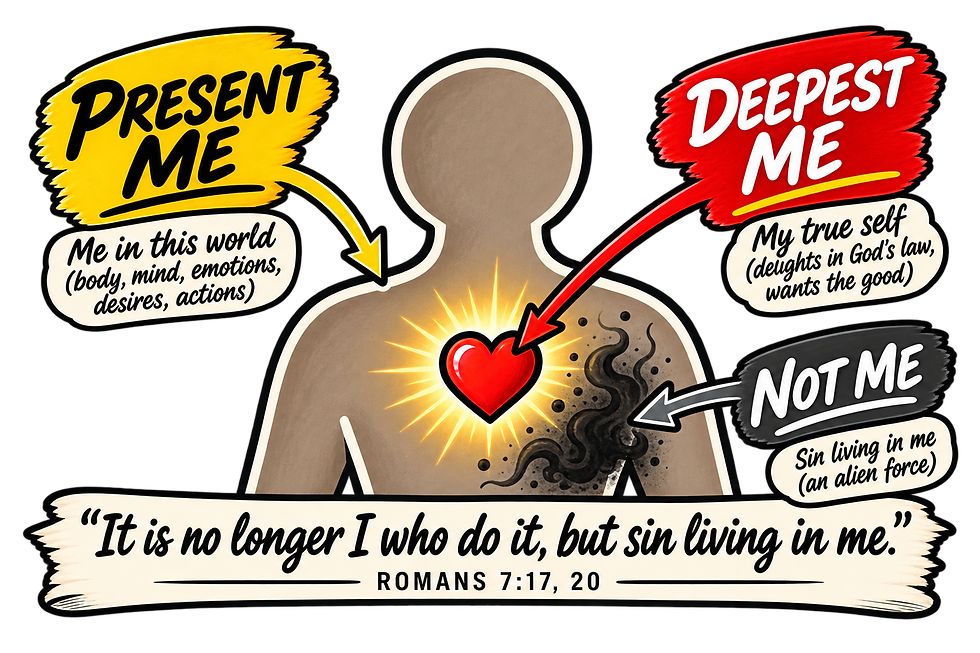
In the above graphic...
PRESENT ME: The sum total of all aspects of me: my deepest self, my spirit, and my flesh. How I present myself to others in this world, including the actions I do, the harm I cause, and the repentance I should offer.
DEEPEST ME: Who I already am and am becoming in Christ. My true self, already cleansed and made holy.
NOT ME: The parasite of sin, fighting against my true self. Not part of the true "I".
There is real wisdom here in that Romans 7 thinking rejects two extremes: denial and despair.
Denial - "It wasn't me!"
Despair - "This is who I am."
Here's an example, inspired from my personal experience:
A Christian falls into old life-destroying habits and ends up stealing a car from a used car dealership. Some time later a Christian brother finds out and confronts him. This brother tells the car thief two things:
First he says: "This is not who you are".
And then he adds: "You need to turn yourself in and face the consequences".
In the overlap of the ages, both things are true.
Think of it this way (yes, I'm over-explaining this point because I want it to be abundantly clear) - if your dog sneaks through a hole in the fence and starts digging in your neighbour's vegetable garden, you don't say: "Hey, it wasn't me, it was my dog. So, not my problem." No, you apologize! And then you offer to repay. And you go to work to repair the fence.
Just because the problem isn't YOU doesn't mean the problem isn't YOURS.

ROMANS 7 & NARRATIVE THERAPY
One last thought about Romans 7. In this chapter the apostle Paul seems to be doing his own first-century version of "Narrative Therapy". Here is an overview of Narrative Therapy - you tell me if you see the connection...
Narrative Therapy acknowledges that our lives are experienced as stories, narratives. We experience things and then we interpret that experience to make it part of our story. Thinking in terms of movies - we see ourselves as living out a story that feels like a drama, a comedy, a tragedy, a romance, or a horror. Once we see ourselves as living within that kind of movie, we continue to interpret our experiences in light of that context.
Our time and place in history is also influencing how we see ourselves and our stories. Every culture has a Dominant Discourse, a metanarrative that we borrow from to help fashion our stories. The time and place in which we live can be very influential, not only in what we experience but also in how we think about our experiences. (This might be a good place to pause and think for a moment of some of the dominant themes of our current culture that influence how we see and interpret our own experiences.)
In the story of us, problems are always one part of that story, but they should never become the total theme of that story. So Narrative Therapy is about helping people see that they are a person apart from their problem. A key theme in Narrative Therapy is:
The person is not the problem; the problem is the problem.
This idea is the basis for a practice called "externalization" - seeing the problem as an invader rather than our identity. People are helped to reframe self-describing adjectives into nouns. For instance:
"I am an angry person" becomes "Anger is trying to take over my life".
"I am so depressed" becomes "Depression is always trying to pull me down".
"I am always anxious" becomes "Anxiety is an ongoing struggle for me."
Problems are seen as separate from persons. Then we can see ourselves (along with our therapist and any other accountability partners) as fighting against whatever the problem is without fighting against ourselves. We can hate the problem without hating ourselves. We can reject the problem without rejecting ourselves.
Narrative Therapy then focuses on "re-authoring" our lives - weaving a new narrative of the future where the problem doesn't win. People learn how not to let the problem have the lead role in the movie of their life, but to take on that lead role themselves with the problem playing a secondary role.
As such, one of the hallmarks of Narrative Therapy is it's commitment to unwavering hope. Once we acknowledge that we are more than our problems, we can go about designing a better story for ourselves moving forward.

So - are you picking up what Narrative Therapy is putting down?
Paul does amazing, even miraculous Narrative Therapy intuitively by refusing to let his story and our story end in the mud and mire of Romans 7. In Romans 6 he talks about our new identity in Christ. Then in Romans 8 he returns to this theme and paints a better future for himself and all of us because of God's relentless love infused into our lives through the Holy Spirit.
It's hard to fight an enemy if you believe the enemy is you. Narrative Therapy - what I think Paul is doing intuitively and expertly in Romans 6-8 - gives us the opportunity to become better versions of ourselves.
And this is key: people who are overwhelmed with shame are not motivated to change. They tend to succumb to the lie that they are defined by their worst experience of human failure, whether something they have done or something done to them. And when that happens, they will tend to move in one of two directions. They will either:
give up (shrivel and die inside) or they will
give in (adopt this shameful identity as their true identity and lean into it, because in the end, we all want to be good at something).
A humiliated, shamed, and downtrodden person is less likely, not more likely, to repent and pursue restitution, restoration, reconciliation.
When someone has committed a grievous sin and we come at them with shame and accusation only, that is, when we confront them as though they are the problem, we are making it less likely that they can own up to the problem and make restitution. We are doing the opposite of Narrative Therapy, the opposite of what Jesus teaches - we are telling them that they ARE the problem, not that they HAVE a problem.
Perhaps that's why the apostle Paul told the early Christians to take a gentle approach to people who are caught in sin:
Brothers and sisters, if someone is caught in a sin, you who live by the Spirit should restore that person gently. But watch yourselves, or you also may be tempted. Carry each other’s burdens, and in this way you will fulfill the law of Christ. ~ The apostle Paul (Galatians 6:1-2)
Of course, there is one significant difference. In Narrative Therapy, the person imagines their own better future and works toward it. In the Gospel, God creates our better future, and it really is better than anything we could have asked for or imagined.
Now to him who is able to do immeasurably more than all we ask or imagine, according to his power that is at work within us, to him be glory in the church and in Christ Jesus throughout all generations, for ever and ever! Amen. ~ The apostle Paul (Ephesians 3:20-21)

THE WAY OUT
The apostle Paul doesn’t let this dark view of the human experience get the last word. After Romans 7, Paul writes Romans 8, which is about life energized by the cleansing power of the Holy Spirit.
THE WAY OUT WITH JESUS...
The movement Jesus started is unique among world religions in that we do not work hard to obtain our goal (salvation, enlightenment, nirvana, paradise, etc). Instead, we receive our ticket to heaven free of charge just by accepting it by faith. When we accept God's grace by faith, Jesus says we have already crossed over into our eternal life, starting here and now.
Very truly I tell you, whoever hears my word and believes him who sent me has eternal life and will not be judged but has crossed over from death to life. ~ JESUS (John 5:24)
We may all have our Romans 7 seasons, but our home lies in Romans 8. Romans 7 describes an experience to which we may sometimes revert, but should not remain.
So when Paul instructs Christians that they have already been made new, this isn't just good theology. For Paul, and for me, this is life support.
Therefore, since we have been justified through faith, we have peace with God through our Lord Jesus Christ, through whom we have gained access by faith into this grace in which we now stand. ~ The apostle Paul (Romans 5:1-2)
Therefore, if anyone is in Christ, the new creation has come: The old has gone, the new is here! ... God made him who had no sin to be sin for us, so that in him we might become the righteousness of God. ~ The apostle Paul (2 Corinthians 5:17, 21)
THE WAY OUT WITH THE SPIRIT...
The Holy Spirit knows the true us and is always helping us remember who we really are so we can live like who we really are, not like a flesh-inspired imposter version of us.
In Galatians, Paul puts it this way:
I say, then, walk by the Spirit and you will certainly not carry out the desire of the flesh. For the flesh desires what is against the Spirit, and the Spirit desires what is against the flesh; these are opposed to each other, so that you don’t do what you want. ~ The apostle Paul (Galatians 5:16-17)
Notice the two you’s! One “you” wants what is right and the other “you” does the opposite. Oy vey, it’s a pickle.
Thankfully, the Holy Spirit will guide us into being and becoming our true selves, if we keep in step with his love and leadership. I know what it’s like to walk in step with the Spirit. And I know what it’s like to wander away. And it is that closeness, or lack thereof, that makes all the difference.
Read Romans 8 and you will find that the Holy Spirit is always filling our hearts with hope, confirming in us that we are dearly loved children of God. Sometimes the Spirit is even moving within us to pray beyond words. Profound intimacy.
THE WAY OUT WITH OTHERS...
Humans were not designed to succeed by ourselves. Notice that none of the lead characters in Obsession show signs of strong relational rootedness. Parents seem (mostly) absent. Apparently, Bear's only family was his grandma and his cat. Nikki is estranged from her father, and her mother is not mentioned. It's not enough to be parented by our peers and learn our lessons from online life. The human soul is designed to flourish within family - biological, communal, and/or spiritual. This movie shows four young adults trying to make complex moral decisions within a self-contained bubble.
I know this kind of relational containment is a classic construct of any good horror movie. But that's the point - relational isolation is a setup for horror. Our lives should be lived differently. Church, for instance, is more important than we think. Obsession reminds me to be grateful for the deep privilege I have of being rooted in a small circle of spiritually meaningful friendships. I am surrounded by others who can give me perspective, wisdom, accountability, and encouragement when I come to them in honesty and openness. What a gift!
At the very least, we should all find someone - even just one person - with whom we can be completely open and honest. And tell them everything. This might be a trusted friend or family member, a spiritual mentor or qualified therapist. We need to let our ears hear our mouth confess to one other person the fullness of who we are and what we are struggling with.
If you don't have this experience in your life, if you're trying to go it alone, please get in touch!

POSTSCRIPT: WHAT COULD HAVE SAVED NIKKI?
Early in the movie Nikki and Bear have a conversation about love and romance. Nikki knows the difference. Bear thinks they are the same thing, and that is the root of some of his worst decisions. In fact, this confusion may be at the root of everything that goes wrong in their relationship, and many relationships.
Romance includes things like passion, playfulness, and desire. It is lovely, but it isn't love. Because romance includes passion and desire, when we put our singular focus on the pursuit of romance, it can become selfish and self-serving. At its best, romance expresses and serves love. When it becomes detached from love, romance lacks the other-centredness that sustains relationships.
Of course, when we are infatuated, when we are obsessed, we feel like we are other-centred, but we are actually centred on our own experience of the other person and not the actual other person.
In the words of the Iris Murdoch:
"Love is the extremely difficult realization that something other than oneself is real." ~ Irish Murdoch (British Philosopher)
This explains why Bear - who is such a "nice" guy! - becomes such a villain as the story progresses. Now that he has Nikki as a romantic partner, he just doesn't know how to love her enough to help her, to set her free, to make the sacrificial decisions that align with love. To be clear, Bear isn't good at romance either, but he would be better at everything if he actually knew what love is. Same goes for all of us.
If I am understanding Jesus' teaching on love correctly...
Love is not doing what makes us FEEL good;
love is doing what IS good despite how we feel.
Jesus says the greatest love is self-sacrifice (John 15:13) - a theme baked into the story of Obsession. And the Bible says Jesus not only teaches us about love, he shows us what love looks like:
This is how we know what love is: Jesus Christ laid down his life for us. And we ought to lay down our lives for our brothers and sisters. ~ The apostle John (1 John 3:16)
So what could have saved Nikki?
Love...
The Hebrew word HESED is often translated in the Bible as lovingkindness. This is the kind of love God offers us, and we ought to offer one another.
A love that is Christ-like because it is self-giving. A love in line with what we see on that tree two thousand years ago. A love only the cross could conjure. A love defined, not by self-protection or self-indulgence, but by self-sacrifice.
I have written an entire article on this last point about love, which you can find here. Or watch our YouTube Video on love here...
------------
Thanks for reading. And hey - if you've made it this far and you've had the chance to see the movie Obsession, I'd so enjoy hearing your take on it, and your thoughts about real love. The comment section is open.
And remember to watch, like, and comment on our Black Sheep Bible Study video on this same topic!


Hi Bruxy,
Good writing, with a touch of hypergraphia, which, I assume, allows for further processing of emotions.
The view that there is a "not me" inside us, human beings, that causes hurtful attitudes and behaviours is similar to the psychoanalytic conceptualization of the psyche in which inner drives, impulses (not accessible to the consciousness) give birth to problematic behaviors. However, although unaware of the source of these problematic behaviors, we are still fully responsible for them. The responsibility arises from the assumption that we remain aware of the attitudes and behaviours that give expression to the "not me" residing in us (the requirement of justice is based upon the assumption that the offensive behavior is under the person's control…
Just read your post “It’s not me”. Nice work Bruxy. I really appreciated the connection you make between Obsession, freedom, and Cain, especially the idea that love ceases to be love when the freedom of the other is removed.
It left me wondering about the “Not Me” language, though. Could there be another way of approaching what God says to Cain? Rather than understanding the destructive desire within Cain primarily as something that is “not Cain,” perhaps God is calling Cain to become aware that not everything arising within him has to become the answer he chooses to give.
“Sin is crouching at the door; and its desire is for you, but you must master it.”
What strikes me is…
Good stuff Brux. Hits a bit too close to home for me though because feeling rightly responsible and properly ashamed of past actions is convenient but inadequate. Convenient now that what’s done is done and the parties have long since parted ways. Inadequate because the feelings dont make things right with those parties. Maybe I’m alright with God, well lucky me. There are some people who would think that was no consolation to them at all.