SM #46: Knowing & Being Known

Updated: Jul 26

“Not everyone who says to me, ‘Lord, Lord,’ will enter the kingdom of the heavens, but only the one who does the will of my Father who is in the heavens. Many will say to me on that day, ‘Lord, Lord, did we not prophesy in your name and in your name drive out demons and in your name perform many miracles?’ Then I will tell them plainly, ‘I never knew you. Away from me, you who work lawlessness!’ ~ JESUS (Matthew 7:21-23)
BEFORE WE BEGIN:
HAPPY NEW YEAR! May 2026 be filled with grace, mercy, and peace.
THANK YOU! I'm so grateful to all of you who have supported 1820 LIFE through your prayers, participation, and finances. This past year we established 1820 LIFE as a non-profit and hope to get charitable status in 2026. But our lack of charitable status has not prevented so many of you from donating and I am very thankful.
YOUTUBE! We have started a new project! I am finally ready to move beyond writing and let my speaking voice be heard again. So I've launched a new YouTube channel. Look for "BLACK SHEEP BIBLE STUDY" on YouTube! (Or click the link below.)


CORE
(The heart of the message)
Knowing Jesus and, even more importantly, allowing ourselves to be known by Jesus, is the goal of the gospel.
CONUNDRUM
(Raising questions skeptics might be asking)
Hey Jesus.
Are you trying to freak us out? After being so encouraging and pro-mercy, now you're telling us that no one can be certain of their own salvation? I'm scared.
What gives Jesus?
"It ain't those parts of the Bible that I can't understand that bother me, it's the parts that I do understand." ~ Mark Twain (Attributed)
"For me, this is the most frightening passage in all of Scripture."
~ Skye Jethani (What if Jesus was Serious)
"These are some of the most terrifying verses of the Bible. ... These verses should send shivers down our spines and cause our hearts to skip a beat." ~ Daniel L. Akin (Exalting Jesus in the Sermon on the Mount)

CONTEXT
(What’s going on before and after this passage)
Earlier Jesus warned that few people will choose to enter the narrow gate and walk along the hard-pressed way. Now he shocks his hearers even more by saying that many who appear to have made the choice to walk the narrow path themselves might not be true believers.
Jesus has just finished warning about wolves in sheep's clothing who are false prophets among God's people. This passage could be read as a deepening and expansion of that same warning.
Now Jesus says, not only is appearing Christian not enough (sheep's clothing). but promoting Jesus is not enough (the double "Lord, Lord" and the triple "in your name, in your name, in your name"). And even channeling (God's?) power is not enough (miracles miracles!). What does Jesus want from us?
These words of warning are doubly challenging because on the surface they appear to contradict other teachings of Scripture:
If you declare with your mouth, “Jesus is Lord,” and believe in your heart that God raised him from the dead, you will be saved. ~ The apostle Paul (Romans 10:9)
Therefore I want you to know that no one who is speaking by the Spirit of God says, “Jesus be cursed,” and no one can say, “Jesus is Lord,” except by the Holy Spirit. ~ The apostle Paul (1 Corinthians 12:3)
By declaring Jesus as Lord, these verses must mean words that come from a sincere heart, that is, words that reflect a genuine heart posture. So it would seem that the people who call Jesus "Lord" in the Judgement Day scenario Jesus is describing do not really mean what their words suggest.
Still, it is fair to declare that upon first reading, this passage provides more questions than answers.
"Ironically, in the end the only ones deceived by the deception were the false prophets themselves. Say things long enough, and you'll eventually believe the words that come from your mouth. This is the danger of living a lie: self-deception." ~ Rodney Reeves (Matthew)

CONSIDER
(Observations about the passage)
Not everyone / Many... Jesus uses two phrases to emphasize that there really are restrictions on getting into the kingdom of the heavens. The word "many" is troubling, and some theologians call it the most frightening word in the Sermon on the Mount.
Lord Lord... In Greek, the word for "lord" (kyrios) can mean one of three things:
a) Sir (A common title of respect)
b) Master (A title of deference to a superior in rank)
c) God (Used in the Septuagint for Yahweh)
Which usage applies to this passage? The double use of the word would have suggested either emotional urgency or divine identity, since it is used this way in the Septuagint (the Greek version of the Hebrew Bible used in Jesus' day) to refer to God. The Septuagint records a total of 18 usages of the double "Lord Lord" (kyrios kyrios), and in every instance it refers to Yahweh, usually translating Adonai Yahweh. In Matthew's Gospel so far, the title kyrios has occurred 11 times prior to this verse, 10 of those instances clearly referring to Yahweh and one time referring to choosing which "Lord/Master" we will serve (6:24). At the same time, after the Sermon on the Mount the word gets used with more variety. Still, Jesus will go on to claim to be "Lord of the Sabbath" (Matthew 12:8), when all Jews believed Yahweh alone was Lord of the Sabbath, since he instituted it in the first place. Later in Matthew, the disciples will "worship" Jesus (Matthew 14:33; 28:17; also see 2:11), something Jews would only offer God (Matthew 4:10), and Jesus does not rebuke them. The word "Lord" appears three times in the Sabbath command of the Ten Commandments (Exodus 20:8-11), all three referring to Yahweh. Lastly, the context of the final Judgement Day suggests that "Lord Lord" is used here as a reference to divinity. The judge on Judgement Day was universally believed by Jews to be God and God alone. So the people in this scene give Jesus the highest honours with their words, but they apparently have not honoured Jesus with their hearts.
These people come near to me with their mouth and honor me with their lips, but their hearts are far from me. ~ Yahweh (Isaiah 29:13)
The kingdom of the heavens... Again we see that, with a few exceptions, the word for "heaven" is used in the plural, especially when connected to the idea of the kingdom. This helps emphasize that the kingdom of God is all around us here and now, not just a distant dimension we will one day enter.
The one who does the will of my Father... Notice that Jesus refers to "my Father" here for the first time in Matthew, and at other times "your Father" and he tells us to refer to God as "Our father". But Jesus never says "Our father" when including himself in the reference (e.g., John 20:17). Jesus always keeps his relationship with the Father distinct. Jesus is not just a fellow human relating to God as the father of us all. Jesus sets himself in a unique Father-Son relationship with God. In Matthew, Jesus refers to doing the will of the Father in the Lord's prayer (Thy kingdom come, thy will be done") and later when he says whoever does the will of the Father is Jesus' true family (Matthew 12:50). Jesus also tells a parable of two sons, one who talks about doing his father's will and the other who actually does it (Matthew 21:31). Doing the Father's will is an important theme for Jesus, and it is how he prays before his crucifixion (Matthew 26:39, 42). What, then, is the will of the Father? How can we know it? The fact is, God's will for us is no mystery. Jesus has just spent three chapters of the Sermon on the Mount telling us. Grace, mercy, and peacemaking; Love for all, including enemies; Forgiveness, simplicity, and nonjudgemental compassion. If we are not open to living this kind of life, we are not open to knowing and being known by Jesus. When assessing a spiritual leader or our own hearts, we must ask, not only are we/they Christian, but do we/they live and help others live out the Sermon on the Mount for starters. Jesus and the apostles repeatedly make this one thing clear: a commitment to follow the teaching of Jesus is the litmus test for whether or not someone is a true disciple of Jesus.
If you hold to my teaching, you are really my disciples. Then you will know the truth, and the truth will set you free. ~ JESUS (John 8:31-32)
And now, dear lady, I am not writing you a new command but one we have had from the beginning. I ask that we love one another. And this is love: that we walk in obedience to his commands. As you have heard from the beginning, his command is that you walk in love. I say this because many deceivers, who do not acknowledge Jesus Christ as coming in the flesh, have gone out into the world. Any such person is the deceiver and the antichrist. ... Anyone who runs ahead and does not continue in the teaching of Christ does not have God; whoever continues in the teaching has both the Father and the Son. ~ The apostle John (2 John 5-9)
"That will is the Torah, understood through Jesus's teaching in the Sermon on the Mount, and that will is the Sermon on the Mount, understood through the rest of the Gospel." ~ Amy-Jill Levine (Sermon on the Mount)
"Jesus commands us to follow him along a simple, humble path: embracing our spiritual poverty, hungering for righteousness, showing mercy to others, overcoming our contemptuous anger and sexual lust, speaking and standing by honest words, loving our enemies, greeting the unlikeable, trusting God for our daily needs, breaking the cycle of hatred and judgement. These are the quiet, simple, Jesus-ordained ways to please our Lord." ~ Matt Woodley (The Gospel of Matthew)
Why do you call me, ‘Lord, Lord,’ and do not do what I say? ~ JESUS (Luke 6:46)
On that day... This phrase is used in Scripture to refer to the final Judgement Day (e.g., Joel 2:1-2; Amos 8:9). This scene seems like more than just a daily missed opportunity to enter the flow of the kingdom of heaven on earth; it is a warning about an impending day of ultimate judgement. Although the traditional view is that this Judgement Day happens exclusively after death, many scholars believe Jesus is also referring to the destruction of the Temple as God's final judgement on the institutionalism and hypocrisy of the whole religious system. Jesus uses this same language in Matthew 24 when describing the destruction of the temple (Matthew 24:11-12).

In your name... Three times these performative Christians say they did what they did in Jesus' name. Like the double "Lord, Lord" the fact that these religious people operate in Jesus' name specifically and not just in God's name generally is significant. These are people who clearly identify as Christian, but do not actually follow the way of Christ, especially as laid out in the Sermon on the Mount. They are either using Christianity as a smoke-screen for their own agenda, or they genuinely believe, but don't care to actually follow. This is what James the brother of Jesus might call "demon faith".
What good is it, my brothers and sisters, if someone claims to have faith but has no deeds? Can such faith save them? Suppose a brother or a sister is without clothes and daily food. If one of you says to them, “Go in peace; keep warm and well fed,” but does nothing about their physical needs, what good is it? In the same way, faith by itself, if it is not accompanied by action, is dead. ... You believe that there is one God. Good! Even the demons believe that—and shudder. ~ James the brother of Jesus (James 2:14-19)
Prophesy / drive out demons / perform many miracles... These goats in sheep's clothing are spiritually gifted. They have the gifts of the Spirit but lack the fruit of the Spirit. Notice that Jesus does not dispute their miracle claims. We should be aware that the ability to perform miracles is not the final proof of anyone's divine connection. Two examples of this in the Bible include the magicians of Egypt (Exodus 7:12, 22) and the demon possessed slave who could prophesy the future (Acts 16:16). Also remember that when Moses disobeyed God and struck the rock with his staff (even though God told him merely to speak to the rock), God still performed the miracle through Moses and provided water for his people. So, we could argue that these miracles could be:
a) faked,
b) demonic, or
c) God's mercy, even though the miracle-worker is not right with God.
The last option is most likely since Jesus says that option b of Satan casting out Satan is a bad strategy and Satan should know this (Matthew 12:26). Powerful spiritual gifts are a blessing and a curse. They are artillery with overwhelming recoil. They may strike our adversary, but also wound those who wield them. Jesus kept this in perspective for his disciples:
I have given you authority to trample on snakes and scorpions and to overcome all the power of the enemy; nothing will harm you. However, do not rejoice that the spirits submit to you, but rejoice that your names are written in heaven. ~ JESUS (Luke 10:19-20)
If I speak in the tongues of men or of angels, but do not have love, I am only a resounding gong or a clanging cymbal. If I have the gift of prophecy and can fathom all mysteries and all knowledge, and if I have a faith that can move mountains, but do not have love, I am nothing. ~ The apostle Paul (1 Corinthians 13:1-2)
Yes the apostle Paul says that spectacular gifts apart from love mean nothing. And yet, if we keep reading, we see that Paul also goes on to say:
If I give all I possess to the poor and give over my body to hardship that I may boast, but do not have love, I gain nothing. ~ The apostle Paul (1 Corinthians 13:3)
Now that's interesting. It seems that a fake Christian, even a supernaturally gifted one, cannot come to their own defense by saying: "But I also did lots of good things for the poor and needy." Maybe they did, but if not done in love, even charitable deeds are still a performance. Jesus knows we can fall into the trap of using even our own kindness towards others as a mere tool for our own ego enhancement. (Pro tip: Beware of those Christian leaders who tend to always make themselves the heroes of their own sermon illustrations.) Love, it seems, is what turns false into true, fake into real. So, we must want to know - what is love?! And for that answer, we simply look at the life and death and life again of Jesus.
"Simple acts are more valuable than extraordinary powers or spiritual gifts." ~ Scot McKnight (Sermon on the Mount)
This is how we know what love is: Jesus Christ laid down his life for us. And we ought to lay down our lives for our brothers and sisters. ~ The apostle John (1 John 3:16)
I never knew you... These words are chilling. First notice that, while Jesus is speaking to his disciples, he tells them he will say these words "to them" not "to you". This is so important. Jesus is not trying to frighten believers, but continuing his warning about false prophets, false teachers, false leaders, or anyone else masquerading as a Christian. The Greek word for knowing (ginóskó; similar to the Hebrew yada') refers to an intimate, relational knowing, sometimes used as a euphemism for sex (e.g., Matthew 1:25). There is a difference between knowing someone and knowing about someone. Jesus knows all about us. God is omniscient. But apparently it is up to us if we will let him in and open up our souls to be truly known by him. Jesus is saying that these people kept him at a distance, refusing intimate relationship. Interestingly, Jesus doesn't debate that they know him. He says they wouldn't let him in to know them. Knowing Jesus is important (John 17:3), but being known by Jesus is equally or maybe even more important (John 10:14; 1 Corinthians 8:3; Galatians 4:9; 2 Timothy 2:19). Jesus uses similar language in his parable of the unwise bridesmaids who arrive late to the wedding celebration and are not allowed to enter. Instead the Bridegroom tells them, "I don't know you" (Matthew 25:1-13, although a different Greek word for "know" is used there). This phenomenon of knowing Jesus but not being known by Jesus has similarities to the delusional stalking of celebrities. A stalker can get to the point where they feel so familiar with and so knowledgeable about a celebrity that they feel like they are in a real relationship. They feel like they know the celebrity, but the test is, does the celebrity know them?

This point is crucial enough to deserve more attention, so we will take it up in more detail in the Confession section below.
I am the good shepherd; I know my sheep and my sheep know me. ~ JESUS (John 10:14)
Away from me... Jesus sees ultimate blessing, heaven, paradise as being with Jesus. What reward could be better? And so, to those who have merely used their Christian identity to gain performative power, fame, and money, Jesus says go away. (The Greek wording here is almost a direct quote of the Septuagint's wording of Psalm 6:8.)
"The message here is that mere confession is useless unless accompanied by action." ~ Grant R. Osborne (Exegetical Commentary on the New Testament)
You who work lawlessness... Jesus claims these people who are unfit for his kingdom are anti-law or anti-Torah, that is, they do not follow God's teaching. The Greek wording behind this idea includes the word for working hard at something (ergazomai) and the word for being anti or without the law (anomia; made from "a" which is a negation + "nómos" meaning law, or torah, or teaching). These people are antinomian, that is, lawless. What "law" does Jesus have in mind? It can't be a direct unfiltered application of the law of Moses, since Jesus has already taught how incomplete that is and even states that merely following the letter of the Old Testament law during these New Testament times comes from "the evil one" (Matthew 5:37). It could mean the Old Testament Torah as fulfilled and interpreted by Jesus. Or, because the word for law or torah can mean teaching, Jesus is likely using it here to refer to his own teaching, which also includes his way of reading, interpreting, and applying the Old Testament, which he has fulfilled (Matthew 5:17; 7:24, 26). In the words of the New Testament scholar Craig S. Keener, "Jesus here refers to his own words as Jewish teachers generally referred to God's law" (The Gospel of Matthew: A Socio-Rhetorical Commentary). Besides, Jesus uses the same word for being "lawless" (anomia) to describe the Pharisees (Matthew 23:28), and we know they tried to keep the Law of Moses meticulously. So Jesus is talking about a law that is deeper - the law of love. In Matthew 24:12, Jesus specifically says that when lawlessness (same word as here) grows, love diminishes, thereby making the law/love connection. Jesus and the early Church leaders often used "commandment" or "law" language to refer to the teachings of Jesus (e.g., John 13:34; 15:10-12; Romans 8:2; Galatians 6:2). Hence, Christians can become "lawless" in at least two ways:
Using New Covenant grace as a license to sin, thereby ignoring the moral principles of God (the error of the Corinthians).
Following the letter of the law apart from the interpretive lens of Jesus, thereby becoming judgemental legalists without hearts shaped by love (the error of the Pharisees and the Galatians).
So Jesus is talking about people who represent Christianity, talk a good Jesus talk, and have all the trappings of following Jesus, except for one thing - they don't actually follow Jesus. They claim to follow the "Word of God" in print, yet do not follow the Word of God in person.
"They are quite impressed with their work. But is any of Jesus' Beatitudes present in their ministries?" ~ Frederick Dale Bruner (The Christbook)
"I fear that so much that passes as Christianity will shrivel up in the day of judgement and be found to be bogus and worthless." ~ Michael Green (The Message of Matthew)
CONFESSION
(Personal reflection)
I confess that I have worked hard to know God while working equally hard to keep God from knowing me. I have played the part of Adam hiding in the bushes. I like to study God, from a distance. Let me explain...

One of my favourite Bible verses is John 17:3. It's beautiful in its simplicity. Jesus is praying to the Father when he says:
Now this is eternal life: that they know you, the only true God, and Jesus Christ, whom you have sent. ~ JESUS (John 17:3)
I paraphrase this verse to say:
Know God.
No Religion.
~ Jesus
Knowing God, knowing Jesus, is my delight. I want to stare into the face of Christ to see the character of our Creator, because Jesus promised:
The one who looks at me is seeing the one who sent me. ~ JESUS (John 12:45; also see John 1:18; 14:6)
When I read about Jesus and think about Jesus and meditate upon Jesus I feel like I'm touching the Divine, and it reassures me that God is love.
So I love the idea of knowing God through Jesus. But...
The idea of God knowing me is - I'm not sure of the right word - unsettling? terrifying? It's like I don't even want to think about the concept. I want to disappear. I want to be an invisible observer. I have always felt this way. (And yes, I get the irony that God has given me public teaching gifts. It's a pickle.)
Through therapy, prayer, and self reflection I have been trying to figure out why this is. I think, deep down inside me, I don't like me. I not only don't want God to know me, and don't want others to know me... I don't even want to know me. I seem to get by day-by-day by refusing to pay attention to who I actually am, lest I spiral into a dark depressive pit of self-loathing. It's like I intuit that the best way to be me in this world is to pay as little attention as possible to who "me" actually is.
When I think of past memories - good and bad, comforting and disturbing, the positive and the negative - it seems like they all make me feel sad. Occasionally my Google photos app on my phone alerts me to a picture and says "Look at what you were doing 14 years ago" or something like that. And you know what? It always makes me sad. I never look.
I'm sad to be me.
I'm sad to have lived my life.
I'm a sad specimen of a human being.
I find it sad that I exist. Yes that's it. I'm so sad that I exist.
If I think about my catastrophic moral failure - I cry.
If I think about my life before my moral failure, when I was oblivious to the depth of my sin potential and naively serving Jesus with joy - I cry more. Because that version of me is dead.
If I go back further in my mind to memories of my youth, when I was just a relatively innocent kid trying to make it through my life and sharing Jesus with my friends whenever I could - I cry the most, because I miss that person.
Recently I had someone ask me about my memories of being a pastor. I started to cry. So they specified: "Tell me some positive memories, about good times and good experiences, about times you felt like you were making a difference." And I cried more. I cried because those good times were now sullied. In some sense, even the good things were bad things because they were set-ups for my crash and burn. It is because of the supposedly good things about me and about what help and healing I brought to others that we were all blind - others and myself - to how far off the straight and narrow I could wander. (Some of you weren't surprised, not because of your knowledge of me specifically but because you have keen insight into universal human potential, and I'm grateful to know you.)
So, because of all of this, I resent the good as well as the bad. I'm sad at the destructive role that everything about me has played. In other words, I see both the good bits and the bad bits as bad bits.
I don't feel like I'm a good person who has done a bad thing. I feel like that bad thing has defined every thing.
(Man, I just reread this confession section so far and I think I need to renew my antidepressant prescription.)
So this whole concept of Jesus not knowing us has been messing me up - in a good way I think.
Those people in my life who are closest to me tell me that I can easily retreat behind a psychological wall, with my true self encased in a lockbox or a safe or an impervious fortress. I think I've always been this way. I love getting to know people, but don't care to have anyone know me. Of course, this ability to be in functional denial about who I am, to be as intentionally out of tune with myself as possible, to make a full-time job out of ignoring that my own inner world exists - that is part of the set up for my moral failure, my psychological fracturing, and my thorough denial.
So here I am, with my lockbox secret soul, trying not to be known, hearing Jesus warn that there will be some people on judgement day who will hear him say "I never knew you." And there is some twisted part of me that whispers, "Ah, success." How nutso is that?
But that twisted part of me is only part of me, and I refuse to think it is the part of me that defines me, that defines who I truly am.
For someone like me with my struggles, I wonder if my complete exposure and humiliation, actually having my secretive soul turned inside out for the world to see (and often misunderstand, misrepresent, and misjudge, but I will have to live with that) - I wonder if that was the greatest gift God could give me once I wandered so far away.
Now I seem to have turned a corner, a kind of acceptance and embrace of being known (and being loved and hated and everything in between). And the depth of rich soul-nourishing fellowship I have experienced as a result, with God and others, has been mind-blowing. The quality of saints that have moved toward and not away from me in the wake of my exposure has been amazingly healing, regenerating the deadened parts of my soul.
So now I refuse to have this sad and secretive inner part of me have the last word. At least, I want to refuse. I believe by faith that there is a deeper me still, a me made for intimacy with God who yearns to know and be known.
It is that faith that keeps me being me, keeps me opening my heart to Jesus and asking him to really know me, keeps me praying along with King David:
Search me, O God, and know my heart; test me and know my anxious thoughts. See if there is any hurtful way in me, and lead me in the way everlasting. ~ King David (Psalm 139:23-24)
When doing my research for the "SM #43: The Heart of the Bible" study on the Golden Rule, I came across the writings of a philosopher named Jeffrey Wattles. Wattles taught philosophy at Kent State University and published a thorough study on the Golden Rule in world religious history for Oxford University Press. I liked his thoroughness and thoughtfulness so much, I got in touch with him to express my gratitude and we had a lovely conversation during which he recommended his new book, A Taste of Joy and Liberty. So I've been diving into that and, again, blessed by what I'm reading, especially on this topic of my confession. God seems to give us what we need when we need it. Jeffrey writes:
"The self we see in the mirror and experience in our minds is not the true and deeper self, the soul. ... Some people struggle to love themselves. If we give this stressful effort a vacation and dare to allow God's love in, we may discover something more soul-satisfying than what we had been striving for." ~ Jeffrey Wattles (A Taste of Joy and Liberty)
I am giving my struggle to love myself a vacation. And I am letting God's love do his work within me.
COMMENTARY
(Thoughts about meaning and application)
We should not miss the biggest Judgement Day surprise in this passage - just who it is who is doing the judging!
In Jesus' day, all Jews believed God and God alone could be and would be the judge we all must face. The Hebrew Scriptures insist that God is the judge of the world (Genesis 18:25; Psalm 7:8, 11; 9:4-8; 50:3-4, 6; 75:6-8; Daniel 7; etc).
Now Jesus puts himself in God's place. Jesus seems to hold what theologians call "a high Christology" of himself. What are we to make of this?
"The implicit christology of the passage should not be missed. Already in the beatitudes and the antitheses, Jesus has assumed an authority that belongs only to God or God's unique representative. Here he pictures himself as acting in God's place as the Last Judge."
~ M. Eugene Boring (The New Interpreter's Bible Commentary)
"Thus Jesus' claim to serve as eschatological judge strongly implies that He recognized himself as Deity." ~ Charles Quarles (Sermon on the Mount)
Throughout church history, different views of who Jesus is have been debated. Here are three:
MODALISM: Jesus is a human manifestation of God the Father - that is, God in disguise, God in a different mode of being. When Jesus speaks of God the Father, he is really just referencing himself in a different form. When Jesus prays to the Father, we are really witnessing his own internal processing. This is called "modalism" - the belief that the one God manifests in different forms or modes. God the Father, Son, and Holy Spirit are like water, ice, and steam. Same things in different forms. (A popular but inaccurate image Christians often use to describe the Trinity. A better image for the Trinity might be the three aspects of an egg - yoke, white, and shell. Different, but they are all "egg".)
ARIANISM: Jesus is on the throne by delegated authority, taking on the role of final judge as a representative of God. This belief agrees that Jesus is more than a regular human, more than just a prophet or gifted guru, but it does not equate Jesus with God. Instead, Jesus is a singularly special spiritual being created by God to represent him (some believe Jesus is actually the archangel Michael). This is called "Arianism" - something our Jehovah's Witness friends believe about Jesus.
TRINITARIANISM: Jesus is somehow distinct from God the Father, yet still fully divine, fully God. God, in this view, is made up of a relationship between persons, not just a single person. This view is called "Trinitarianism" - the belief that God is one, yet consists of three persons in harmony, unity, and loving relationship. In these 1820 writings we take a trinitarian approach, not because the humans who first expressed the doctrine of the Trinity are trusted as infallible, but because it seems to wrestle with the biblical data most honestly, allowing for the paradoxical scriptural data set of verses claiming that Jesus was fully human and distinct from God along with those that seem to suggest that Jesus was fully divine. Trinitarianism promotes the internal inherent relationality of God. The trinitarian approach has the most explanatory power to make sense of the profound idea that "God is love" (1 John 4:8, 16).

The Council of Nicaea in 325 AD became a showdown between Arius, a Christian priest who believed Jesus was a created being subordinate to God the Father, and Athanasius, a Church Father and bishop, who staunchly defended the belief that Jesus was coeternal and consubstantial (of the same essence) with the Father. The Council of Nicaea ended with the formulation of the Nicene Creed, ultimately condemning Arianism as a heresy and promoting the Trinitarian view as the official Christian view.
One interesting historical tidbit from the Council of Nicaea is that moment when Santa Clause lost his temper...
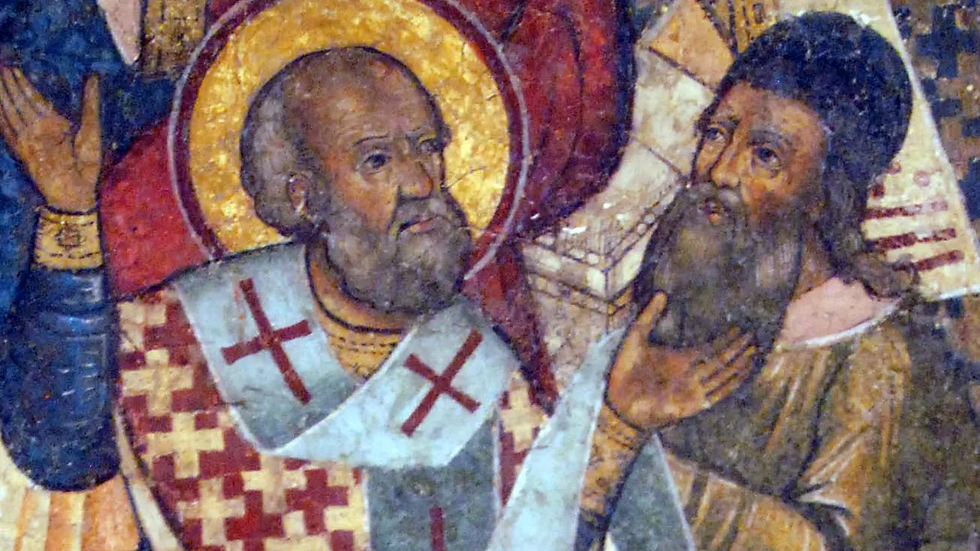

In the end, Christians may do well to spend less time, energy, and effort arguing over the internal ontology of God's essence and more time, energy, and effort exploring how to live out the love ethic of the Sermon on the Mount. When we do that, we will at least love, honour, and respect one another better when we do talk about our disagreements.
Today people who lean toward any or none of these three groups (and others who are still sorting out what they believe about God) can gather together around the Sermon on the Mount to read it, live it, and grow more Christlike. (And no one needs to get (slapped!) We can trust that whichever view of Jesus is closest to the truth will become more evident over time.
Those of us who take the Sermon on the Mount seriously cannot escape the fact that this brilliant moral philosopher, this genius we call Jesus, saw himself as the final judge sitting on God's throne. Whatever we make of this, we need to acknowledge that Jesus saw himself as the hinge of our history - past, present, and future.
If Jesus is right, what we make of Jesus will be the most important choice we ever make.

Jesus asked. “Who do you say I am?” Simon Peter answered, “You are the Messiah, the Son of the living God.” Jesus replied, “Blessed are you, Simon son of Jonah, for this was not revealed to you by flesh and blood, but by my Father in heaven." ~ The apostle Matthew (Matthew 16:15-17)
CONCLUSION
(One last thought)
Once more for those of us who need reassurance: the false believers in this passage never mention the teaching of Jesus or trying to follow his instructions. They are not the ones dedicated to a Sermon on the Mount study and application, like you are if you're reading this. Rest In Peace.
Now, for those of us still wrestling with who Jesus is... Jesus gives all of us this amazing challenge - apply my teaching to your life and let the results convince you of who I am.
My teaching is not my own. It comes from the one who sent me. Anyone who chooses to do the will of God will find out whether my teaching comes from God or whether I speak on my own. ~ JESUS (John 7:16-17)
If you're struggling to figure out who Jesus is - the Son of God or just a really wise Jewish philosopher - commit yourself to living out his teaching. Try it on for size. Give it a test drive. Maybe for a few months, or better for a year, or even better for three years (the length of time Jesus mentored his original disciples). The results will convince you.
Jesus is not looking for spectacular world-changers. He's looking for quiet mercy-givers. We can do this. We all can do this. Let's go do this.
"Get up, and do something the master tells you; so make yourself his disciple at once. Instead of asking yourself whether you believe or not, ask yourself whether you have this day done one thing because he said, Do it, or once abstained because he said, Do not do it. What have you done this day because it was the will of Christ? Tell me something that you have done, are doing, are trying to do because he told you." ~ George MacDonald (The Truth in Jesus, in Unspoken Sermons)

POSTSCRIPT: As someone pointed out in one of our 1820 Life groups, if we take away one thing from this Judgement-Day passage, let it be this: Jesus wants to know us. He thinks we are worth knowing. And he wants us to engage with him in open, honest, and intimate relationship.
Amen.
CONTEMPLATE
(Scripture passages that relate to and deepen our understanding of this topic)
Philippians 2:5-11
CONVERSATION
(Talk together, learn together, grow together)
What is God revealing to you about himself through this passage?
What is God showing you about yourself through this passage?
Which is harder for you: knowing God (Bible study, conversations about God, prayer, etc) or allowing yourself to be known by God (consciously refusing to keep secrets in your connection with God, but praying about and offering to God your deepest self, total surrender)?
What is one thing you can think, believe, or do differently in light of what you are learning?
What questions are you still processing about this topic?
CALL TO ACTION
(Ideas for turning talk into walk)
Take the George MacDonald Challenge. Re-read the George MacDonald quote in the conclusion above and determine one thing that you would not normally do but that Jesus asks you to do, and then go and do it. (You may need to name it, write it down, then tell someone and ask them to ask you about it later.)
Let Yourself Be Known. Make yourself fully known to one other person, whether closest of friends or formal therapist. Make sure someone fully knows you and still loves you as a reminder of God's knowing and loving you.
Talk to God About All Your Secrets. Spend time talking to God about the things in your life that you are tempted to be in denial about. Sense his conviction as well as his love and cleansing.

At small church, what you said as an answer to Hans, is what needs to be printed.
How will Jesus will know us? By how we love without expecting reward or notice.
Listing the Sermon on the mount "what love looks like points" is EXCELLANT!!